Our history
- 1880The house was a carriage house and servants' quarters owned by Ezra Cornell, the founder of the University.
- 1912Edward Amherst Ott and his wife bought the house from Mary E. Cornell and Emma C. Blair.
- 1923–1925The house was remodeled.
- 1933“Dr.” Ott and Alva L. Tompkins, head of Cornell United Religious Works, developed a cooperative living association. The dining room was organized the same year as the Llenroc Dining Association, Inc. — in 1934 it opened to the public and at times served as many as 125 people.
- 1937Incorporated November 30, 1937 as the Llenroc Lodge Association.
- 1938On March 29, 1938 the house was turned over to the students. In return, Dr. Ott was to receive an annuity when he retired and to be advisor as long as he wished.
- 1939A group of senior students who disagreed with the house liquor rules (this was a dry house until 1971) broke away and formed Algonquin Lodge, also on Stewart Ave.
- 1940On July 22, 1940, at the request of Delta Phi (also known as Llenroc Lodge), the name was changed to Cayuga Student Residence Association.
- 1955The name was changed again to the now-familiar Cayuga Lodge, Inc.
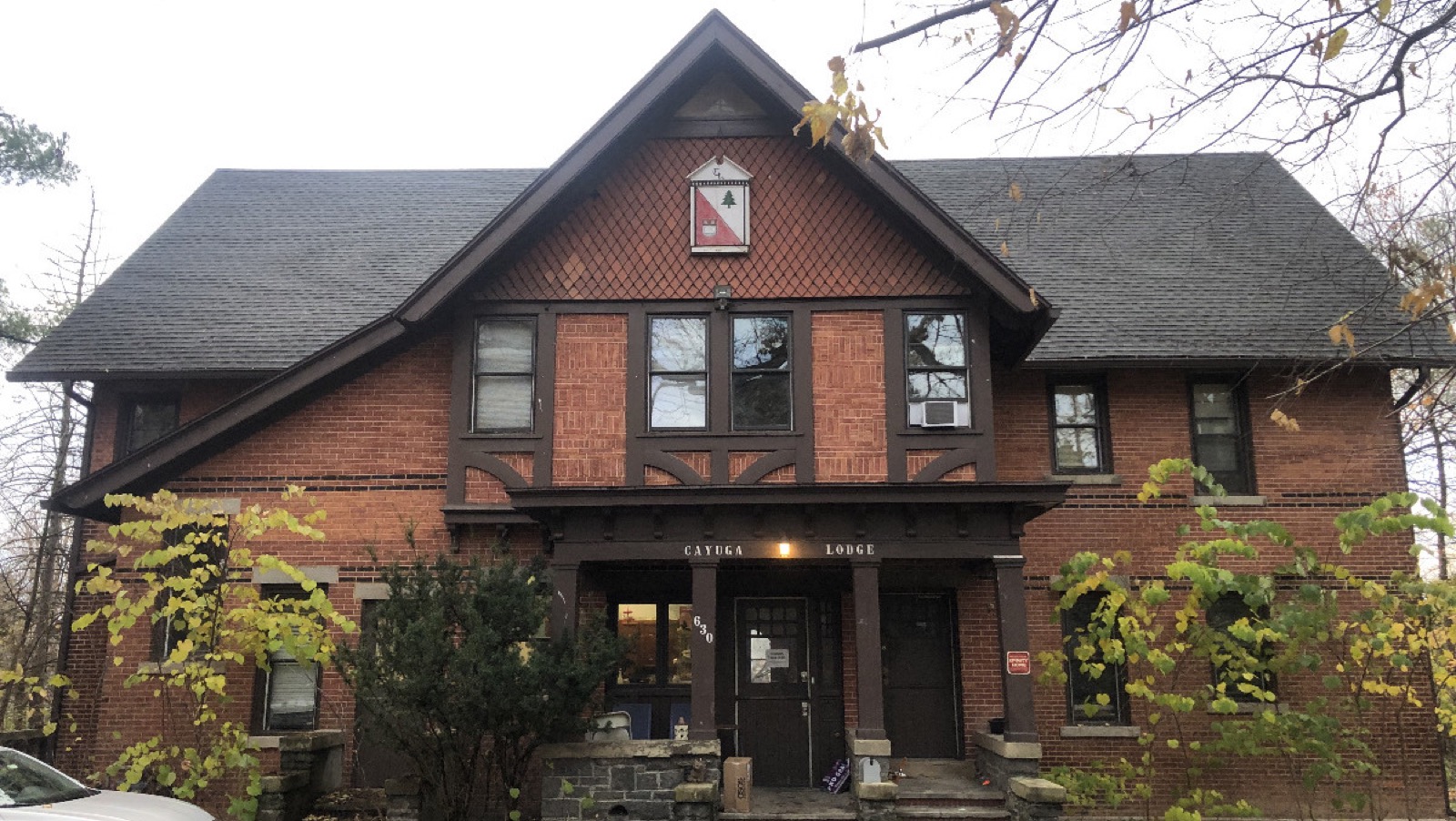
The crest
The Lodge symbol is a small Cornell symbol on a field of red, which stood for the house's tie to the University. Opposite it, the evergreen tree is the cooperative symbol. The shepherd's crook stands for leadership and the sword stands for truth.
Today the Lodge is independent and not affiliated with Cornell University.
About “Dr.” Ott
Edward Amherst Ott was born in Youngstown, Ohio in 1867. He attended Hiram College and studied English at Drake University. He later became president of the Ott School in Chicago and was a well-known Lyceum lecturer, and he earned the title “Dr.” on a lecture tour of the South in 1920. The cooperative was novel enough to make the newspapers, and it was “considered an honor to be selected as a member of the Lodge.”
Have old photos or stories? Share them in Lodge Memories.